When Courts Fail to Enforce Forced Labor
Brazil's Labor Ministry defied a judicial order to expose corporate slavery—revealing how political power makes documented exploitation invisible to compliance teams
Brazil's federal government missed a court-ordered deadline on 18 December 2025. Five days earlier, Judge Katarina Roberta Mousinho de Matos had commanded the Labor Ministry to add three companies to Brazil's Lista Suja—the official registry of employers caught using forced labor. The deadline passed. The Ministry did nothing. A $3,720 daily fine began accumulating against the public treasury.
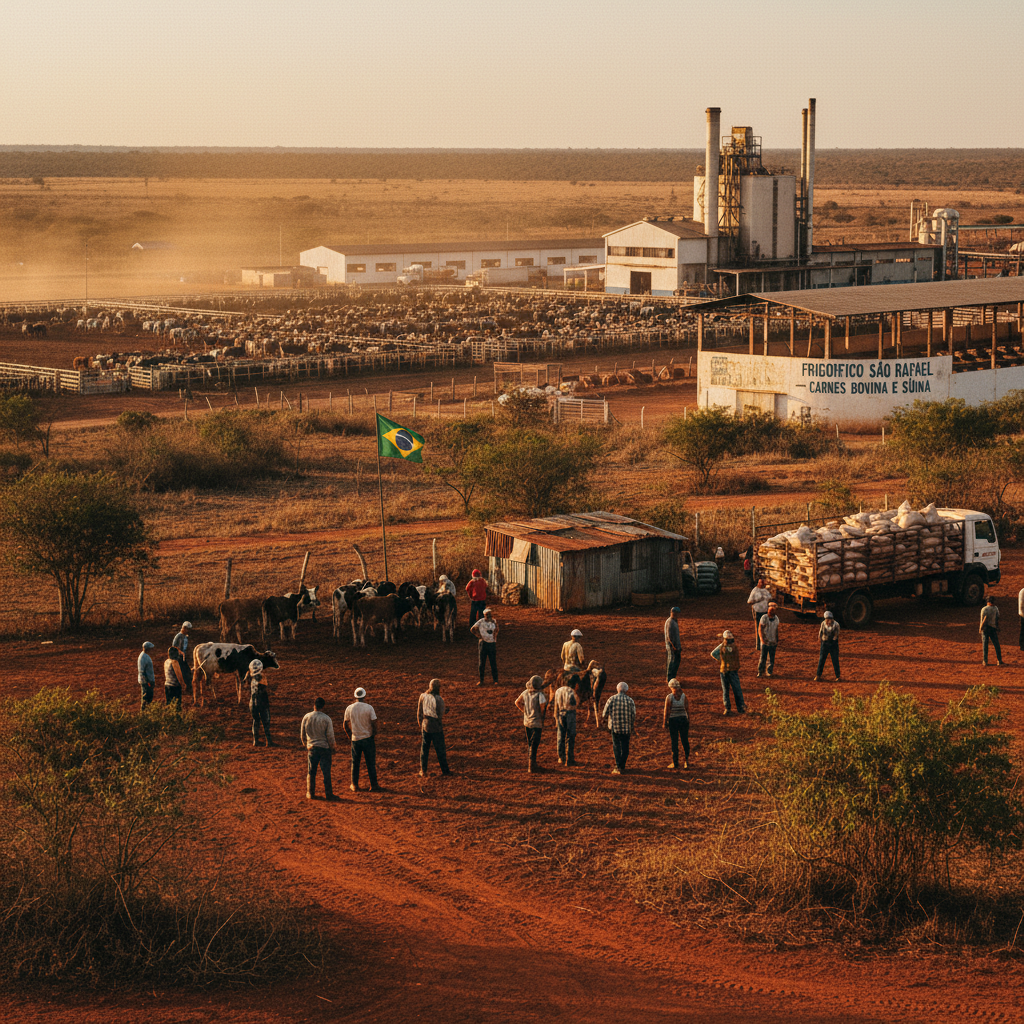
JBS Aves was the company at the center of the standoff. It is the poultry subsidiary of JBS S.A., one of the world's largest meat companies with operations across six continents and annual revenues exceeding $60 billion. In December 2024, labor inspectors in Passo Fundo, Rio Grande do Sul, had rescued ten workers from conditions Brazilian law classifies as analogous to slavery—sixteen-hour workdays, workers fed chickens discarded as "below JBS standards," and debt bondage arrangements where employees worked to repay charges for transport and meals.
The government's defiance isn't accidental. It follows an unprecedented intervention by Labor Minister Luiz Marinho, who in September 2025 used an obscure 1943 legal mechanism to erase three completed forced labor investigations from official records. The workers were rescued. The conditions were documented. But administratively, and for compliance check purposes, the slavery never happened.
The Invisible Override
The mechanism Marinho deployed is called "avocação"—a provision dating to 1943 that allows ministers to personally review enforcement decisions. It had never been used to overturn completed forced labor investigations after workers were already rescued. Marinho changed that, calling three cases to his desk after auditors had finished their work; all appeals had been exhausted, and companies were scheduled for Lista Suja publication.
The timing was crucial. Brazil's Lista Suja updates semi-annually. Marinho invoked avocação just before scheduled publication dates in September and October 2025, preventing JBS Aves, Santa Colomba Agropecuária, and Apaeb (a sisal fiber cooperative) from ever appearing on the registry. Standard due diligence processes—screening suppliers against the Lista Suja, checking enforcement databases, verifying compliance certifications—showed nothing. The companies remained “clean.”
The federal legal counsel (AGU) provided cover, arguing the intervention was justified given "the exceptional gravity of the case, the economic relevance of the companies involved, and the public interest in uniform legal interpretation." In her December ruling, Judge Matos noted the AGU had admitted to "robust indications" of slavery but recommended review based on "economic repercussions"—making explicit that economic importance, not legal standards, drove the decision.
The Institutional Revolt
The response from within Brazil's labor enforcement system was immediate and unprecedented. Multiple state-level coordinators of the anti-slavery inspection program resigned in protest. On September 30, 2025, Anafitra (the national association of labor inspectors) filed a constitutional challenge with Brazil's Supreme Court arguing the minister's actions violated fundamental principles of inspector independence.
The legal challenge centers on Brazil's international obligations. As a signatory to ILO Convention 81, Brazil must ensure labor inspection remains "free from any improper external influence." The Inter-American Court of Human Rights reinforced this in its 2016 Fazenda Brasil Verde ruling, holding Brazil internationally responsible for failing to investigate forced labor. The court ordered Brazil to ensure administrative mechanisms don't obstruct investigations into slavery—precisely what ministerial avocação achieves.
Mário Diniz, an Anafitra coordinator, framed the systemic problem: "This creates a third appeals instance that doesn't exist in law. If the minister can overturn any completed investigation based on a company's economic importance, the entire technical inspection system becomes optional for powerful companies."
The Public Labor Prosecutor's office (MPT) escalated further, filing suit to force Lista Suja inclusion. Judge Matos ruled in their favor on December 2, 2025 calling the minister's intervention a "deviation from purpose" that created a "regime of exception for large companies." She explicitly prohibited future use of avocação to delay or prevent Lista Suja publication and warned that continued interference could constitute criminal disobedience, administrative abuse, and violations of democratic rule of law.
The government appealed and continues to refuse compliance. As of early January 2026, JBS Aves, Santa Colomba, and Apaeb remain absent from the Lista Suja despite court orders and accumulating fines. The Labor Ministry claims it will wait until the scheduled May 2026 update—ignoring that dozens of companies have been added or removed outside regular publication cycles when courts ordered it.
The Compliance Challenge
For corporate compliance teams, this creates a category of invisible risk that conventional screening cannot detect. A supplier checks out as “clean” because it is not on the Lista Suja. The company appears in no enforcement databases. Standard certifications show no flags.
JBS operates as a major global supplier, publicly traded on both the New York and São Paulo stock exchanges, employing 158,000 workers in Brazil alone. Companies sourcing Brazilian poultry, beef, or leather through JBS supply chains face exposure under multiple regulatory frameworks: the UK Modern Slavery Act, Germany's Supply Chain Due Diligence Act, the EU's Corporate Sustainability Due Diligence Directive, and the US Uyghur Forced Labor Prevention Act. All require companies to identify and remediate forced labor in their supply chains.
But identification depends on visibility. When a government can administratively erase documented slavery with a ministerial signature—and then defy judicial orders to publish it—compliance processes built around official registries fail completely. The Lista Suja was created in 2003 specifically to provide transparency. Since then, Brazil has rescued over 65,000 workers and paid more than R$155 million in back wages. The system worked for two decades. Until political intervention made it optional for economically significant companies.
This is why supply chain transparency requires big data and data based on ground-sourced information. When governments can make forced labor invisible even to courts, seeing what conventional tools miss isn't just better practice—it's the only way to avoid liability that exists nowhere in the official record, protected by ministerial decree and governmental defiance of judicial authority.