Forced Labor on a Floating Squid Factory
How China's Squid Fleet Hides Labor Abuse in International Waters
The Ghost at Mile 201
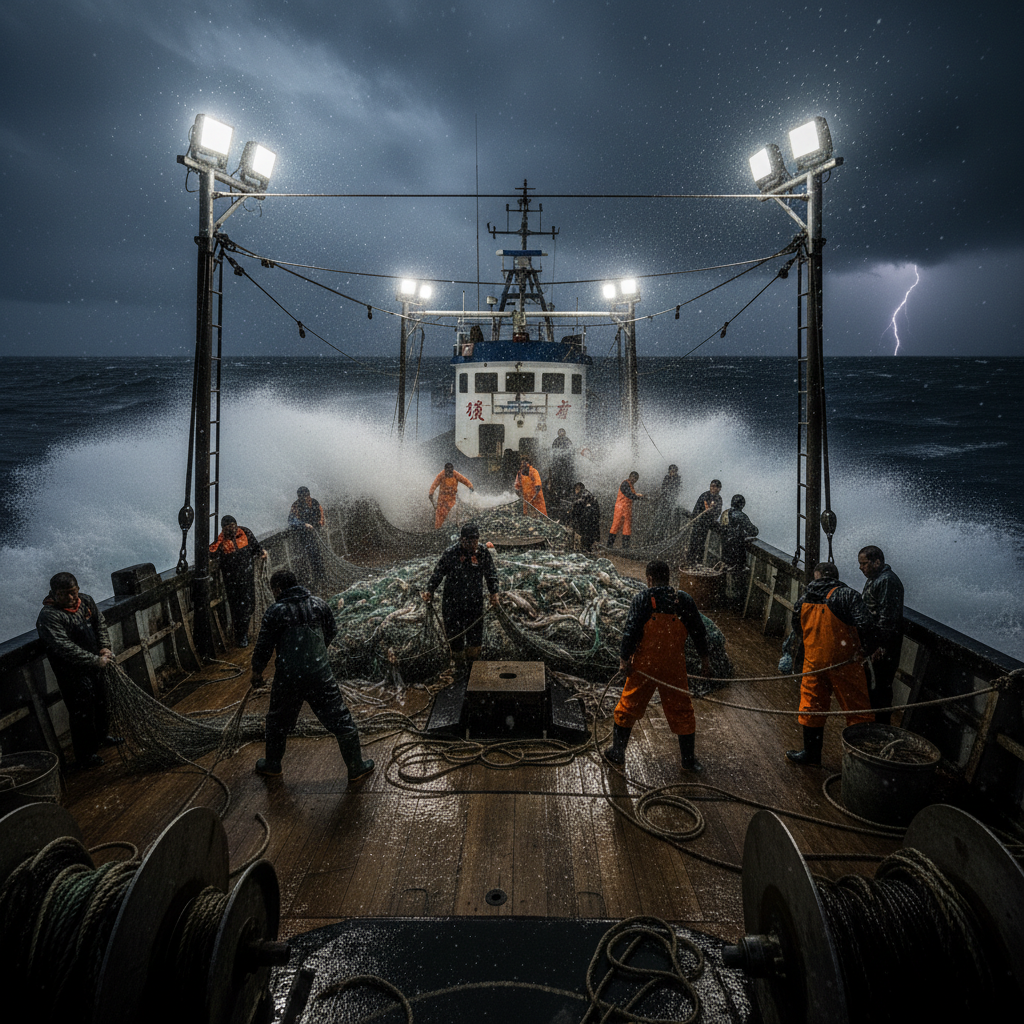
The Lu Rong Yuan Yu 956 disappeared from satellite tracking at 2:47 a.m. on March 12, 2025. One moment, the 60-meter squid jigger was a blinking dot on the Argentine Coast Guard's radar, hovering just beyond the 200-nautical-mile line—the invisible border where Argentina's exclusive economic zone ends and the lawless high seas begin. The next moment, the vessel's Automatic Identification System went dark.
Commander Mauricio López knew what this meant. The ship was hunting.
By dawn, the Lu Rong Yuan Yu had slipped 40 miles inside Argentine waters, its deck ablaze with industrial floodlights, its automated jigging machines hauling up Argentine shortfin squid by the ton. When the Coast Guard cutter finally caught up, the Chinese vessel fled at full throttle, crew frantically dumping evidence overboard. But the real crime wasn't the illegal catch. It was the men locked below deck.
Inside the hull, Indonesian and Filipino fishermen worked 20-hour shifts under conditions the Environmental Justice Foundation would later describe as "floating prisons." Their passports were locked in the captain's safe. Their wages were phantom numbers in ledgers controlled by labor brokers thousands of miles away. Some had been at sea for two years without touching land. When investigators finally interviewed crew members who escaped, they described systematic debt bondage, physical violence, and the deliberate killing of hundreds of seals—their teeth harvested as trophies, their bodies dumped overboard.
The Lu Rong Yuan Yu 956 is not an outlier. It is one node in a vast transnational network designed to operate beyond the reach of law, beyond the scope of corporate audits, and beyond the visibility of standard due diligence. By the time its catch reaches a supermarket in London or New York—processed through Chinese export hubs, laundered through at-sea transshipments, and labeled with the sanitized language of "sustainable seafood"—the blood has been thoroughly covered up by layers of corporate opacity.
This is the architecture of invisibility hiding in plain sight, just beyond Mile 201.
Mapping the Architecture of Invisibility
When due diligence teams screen seafood suppliers, they see what the system is designed to show them: vessel registrations, flag state certifications, and export licenses. What they don't see is the three-layer network that makes the Lu Rong Yuan Yu 956 and vessels like it functionally invisible to corporate accountability.
Layer One: The Beneficial Ownership Maze
The Lu Rong Yuan Yu 956 is registered to Rongcheng Wangdao Ocean Fishery Co., a company based in Shandong Province. Standard screening stops there. But beneficial ownership research reveals a different picture: Wangdao is one of dozens of subsidiaries controlled by holding companies with ties to state-backed fishing conglomerates. The individuals who profit from illegal fishing and labor abuse are hidden behind shell companies, nominee directors, and opaque corporate registries that span multiple jurisdictions.
China's distant-water fishing industry operates through a deliberate corporate architecture designed to fragment accountability. A single fishing operation might involve a vessel registered in one province, ownership structures in another, financing from state-backed banks, labor recruitment through third-party agencies in Southeast Asia, and catch processed and exported through coastal hubs like Zhoushan. Standard vessel databases capture the registration. They miss the network.
Layer Two: The Labor Intermediary System
The Indonesian and Filipino crew aboard the Lu Rong Yuan Yu weren't hired by the vessel owner. They were recruited by labor agencies—maritime equivalents of the gato contractors in Brazil's soybean fields—that specialize in sourcing workers for distant-water fleets. These agencies operate across borders, charging recruitment fees that trap workers in debt bondage before they ever board a ship.
Workers pay $1,000-$3,000 in recruitment fees, sign contracts in languages they don't understand, and surrender their passports upon boarding. Once at sea, they're beyond the reach of labor inspectors, consular officials, or law enforcement. The agencies that recruited them vanish into the bureaucratic gaps between Indonesia, the Philippines, and China. The vessel owners claim ignorance. The labor brokers claim they're just middlemen.
This is the deliberate fragmentation of liability. No single entity is responsible because the system is designed to ensure no single entity can be held accountable.
Layer Three: The Supply Chain Laundering Network
The squid hauled aboard the Lu Rong Yuan Yu never will never reach port by that vessel. It is transferred at sea to refrigerated cargo ships—a practice called transshipment—that aggregate catch from dozens of vessels. By the time the squid reaches processing facilities in China, its origin has been scrubbed from the supply chain. It's mixed with legally caught squid, processed into frozen fillets or dried products, and exported with documentation that lists only the processing facility, not the fishing vessel.
From there, it enters global distribution networks. A retailer in London conducting due diligence sees a Chinese seafood exporter with proper export licenses and quality certifications. They don't see the Lu Rong Yuan Yu. They don't see Commander López's pursuit. They don't see the men locked below deck.
This is what Illicit Network Intelligence (INI) is built to reveal: the hidden connections between the vessel at Mile 201, the shell companies in Shandong, the labor brokers in Manila, the transshipment operators in international waters, and the processing facilities that launder the catch into legitimate commerce. Standard screening tools see isolated data points. INI maps the network that connects them—and exposes the individuals who profit from the system's invisibility.
From Plausible Deniability to Legal Liability
For seafood importers and global retailers, the
Lu Rong Yuan Yu 956 represents more than an environmental scandal—it's a compliance failure with financial and legal consequences. The "architecture of invisibility" that once provided plausible deniability is being reclassified under new regulations as a failure to exercise "reasonable care."
The regulatory landscape has shifted from voluntary commitments to mandatory enforcement. The European Union's ban on products made with forced labor, combined with Corporate Sustainability Due Diligence Directive requirements, mandates that companies identify and mitigate human rights risks across their entire value chain, not just direct suppliers. This explicitly includes the transshipment operators and labor recruitment agencies that standard audits never touch. A UK supermarket chain sourcing squid cannot claim ignorance of the
Lu Rong Yuan Yu's crew conditions when the regulatory standard is now "map the network or face market exclusion."
Expanded U.S. Seafood Import Monitoring Program requirements demand granular chain-of-custody documentation. If a shipment of squid cannot be traced to a specific, compliant fishing vessel—not just a processing facility—it faces immediate seizure at U.S. ports. The transshipment model that obscures vessel origin is now a customs red flag, not a business-as-usual practice.
In an era of investigative journalism and ESG activism, the gap between sustainability marketing and the reality of debt-bonded labor creates real brand risk. When NGO investigators can document forced labor on specific vessels, and network analysis can trace that catch to specific retailers, the "we didn't know" defense is harder to leverage. Investors and consumers increasingly treat supply chain opacity itself as evidence of complicity, or benign neglect at best.
A single contaminated shipment can trigger cargo seizure, legal defense costs, regulatory fines, and suspension of "trusted trader" status that delays all future imports. The cumulative cost dwarfs the investment in due diligence. Yet most companies still rely on screening tools that see the Rongcheng Wangdao export license but miss the
Lu Rong Yuan Yu and the men locked in its hull because these tools rely on big data, not data intelligence.
This is the compliance gap that Illicit Network Intelligence (INI) closes. When regulators demand you map your supply chain to the vessel level, when investors demand you identify beneficial owners behind shell companies, when enforcement agencies demand you prove no forced labor touched your product—INI provides the network visibility that transforms regulatory requirements from impossible burdens into manageable risk mitigation.
The Cost of Looking Away
The Lu Rong Yuan Yu 956 is still fishing. So are the hundreds of vessels in its network. They operate in the same jurisdictional void, employ the same labor intermediaries, and feed the same supply chains they always have. What has changed is not their behavior—it's the regulatory and reputational cost of pretending they don't exist.
Corporate due diligence built on supplier questionnaires and facility audits was designed for a different era. It cannot see Mile 201. It cannot map the shell companies in Shandong or the labor brokers in Manila. It cannot trace the transshipment that scrubs a vessel's identity from the supply chain. This invisibility is a the central risk in global seafood sourcing.
The men locked below deck on the Lu Rong Yuan Yu are counting on someone to look beyond Mile 201. So are your shareholders, your regulators, and your customers. The question is whether you'll see the network before it sees you.