The Iran conflict is funding Russia’s war machine
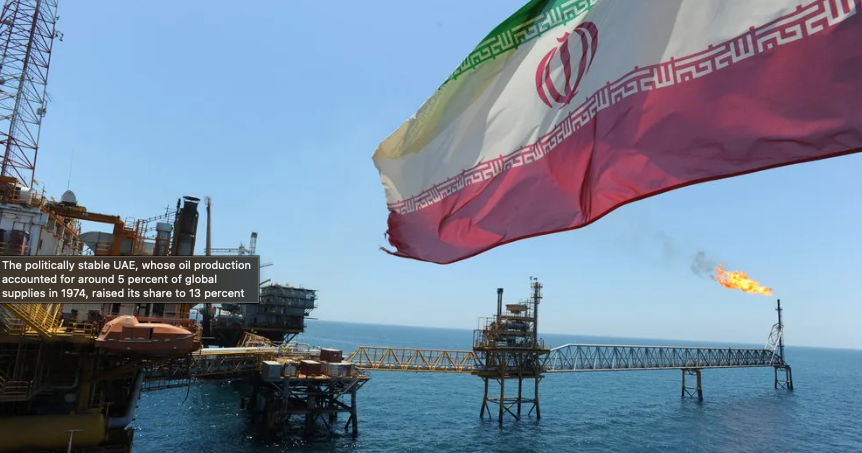
Oil prices spiked $30 a barrel the day the bombs fell. For Gazprom, Rosneft, and Lukoil, a windfall followed. For the regulators trying to stop Russian war revenue faced a familiar problem: the money is moving, and they can’t see where.
by Evidencity | AI Assisted | 100% Human Verified
The US-Israeli war in Iran pushed the price of Brent crude to an average of $100 a barrel in March, according to an analytical baseline used by
Rystad Energy and Global Witness to model windfall profits. Russia’s Urals crude averaged
USD 94.5 per barrel that month, a 67% month-on-month rise, and oil export revenues into the Kremlin’s coffers hit
$840m a day in March, 52% higher than February, according to analysis by the Centre for Research on Energy and Clean Air.
Gazprom, Rosneft, and Lukoil, three companies that collectively sit at the heart of Russia’s state energy apparatus, are on track to collect an estimated
$23.9bn in Iran-related war profits by the end of 2026, according to Rystad Energy data. That figure represents profit above and beyond their baseline earnings: unearned revenue generated by the geography of a conflict 2,000 kilometres from Moscow.
The money flows directly into a Kremlin war chest that continues to fund Russia’s grinding offensive in Ukraine. On paper, it looks like a corporate windfall; in practice, it is a war financing mechanism, and one that sanctions regimes on both sides of the Atlantic have so far failed to shut down.
Architecture built to outlast enforcement
All three companies are sanctioned. The US Treasury’s Office of Foreign Assets Control
added both Rosneft and Lukoil to the SDN list on October 22, 2025. The EU imposed a full transaction ban on Rosneft and Gazprom Neft. But there is architecture in place to survive exactly this type of sanctioning regime. It lies in the intermediary layer.
The critical enforcement mechanism, secondary sanctions on third-country buyers and intermediaries doing business with designated entities, has not been systematically deployed. The pattern is established: after earlier sanctions rounds, designated companies restored sales volumes through intermediary traders, and no significant secondary sanctions were imposed on their partners. This way the oil profits keep moving.
This is the product of deliberate corporate architecture: ownership structures and trading entities designed to create legal and jurisdictional distance between the sanctioned parent and the transaction that matters.
Lukoil’s UAE-registered subsidiary, Litasco Middle East DMCC, offers an instructive example. The entity was separately
sanctioned by the EU as part of its 19th Russia sanctions package, but only after it had already served its function as a clean-looking intermediary in a jurisdiction with lighter oversight. Meanwhile, OFAC general licences authorising limited, time-bound transactions involving certain Lukoil entities outside Russia and in Bulgaria were
extended as recently as April 14, 2026, a sign of how carefully regulators have had to manage the unwinding of a company with deep roots in non-Russian retail and refining markets.
The result is a
fragmented, jurisdiction-divergent environment where enforcement lags are structural rather than incidental. Russian crude continues flowing to buyers in Asia and Africa through intermediary chains that are difficult to trace and harder still to sanction without triggering secondary effects that Western governments, acutely conscious of fuel prices, have been reluctant to risk.
The IEA’s head, Fatih Birol, has called the Iran war the
biggest shock ever to global energy markets. The shock has been good for Russia.
Intermediaries Continue to Present a Glaring Concern
For corporate counsel and compliance professionals, the SDN listing should be the beginning of the analysis, not the end of it. The risk lies in the layers beneath: the intermediary trading entities, the offshore subsidiaries, the shadow fleet operators providing maritime logistics for Russian crude, and the transactions that connect them to counterparties that, on the surface, look clean.
The EU’s proposed windfall tax on oil company profits, backed by
five EU member states (Austria, Germany, Italy, Portugal, and Spain) and modelled on the 2022 gas crisis mechanism, will force regulators to look harder at where these profits actually sit and who controls the entities collecting them. That scrutiny is overdue. It will also be difficult: the 2022 mechanism struggled to reach profits routed through offshore trading structures, and the current architecture is no simpler.
This is precisely the problem that
Evidencity’s Illicit Network Intelligence (INI) is built to address. Mapping the second and third-tier entities that sit between a sanctioned parent and a seemingly legitimate transaction requires forensic network intelligence at scale because the $23.9bn flowing toward Gazprom, Rosneft, and Lukoil this year will not travel in a straight line.
The war in Iran handed Russia a windfall. The structures built to collect it were ready long before the first bomb fell.