Washington designated the traders, not the smelter
OFAC sanctioned the Rwanda Defence Force and the Hong Kong traders moving conflict tantalum out of eastern DRC. The mineral passed through both of them on its way to Ulba Metallurgical Plant, a Kazakh state asset, the only tantalum processor in the former Soviet satellite state, and a fixture in the certified supply chains of major Western manufacturers.
On 2 March 2026, the U.S. Department of the Treasury’s Office of Foreign Assets Control sanctioned the Rwanda Defence Force and four of its senior commanders for actively supporting M23 rebels in the eastern Democratic Republic of the Congo, seizing territory, taxing coltan mines, and sustaining the conflict mineral ecosystem that has destabilised the region for decades.
The designation landed eight months after OFAC had sanctioned the traders who moved the mineral. By then, the tantalum had already cleared Kigali. It had already been processed in Kazakhstan. It was already sitting in a certified supply chain, disclosed in an SEC filing, carried by an S&P 500 manufacturer, which in turn was protected by an audit that was never designed to ask the right questions.
Evidencity’s Illicit Network Intelligence (INI) mapped every node in that chain before a single sanction landed. The network runs from armed-group-controlled mines in North Kivu, through a UK mining executive and a Swiss businessman under criminal investigation, through two Hong Kong trading companies now on the OFAC list, through a Soviet-era smelter owned by the Kazakh state, and out the other end bearing the stamp of a responsible minerals certification that has never been revoked.
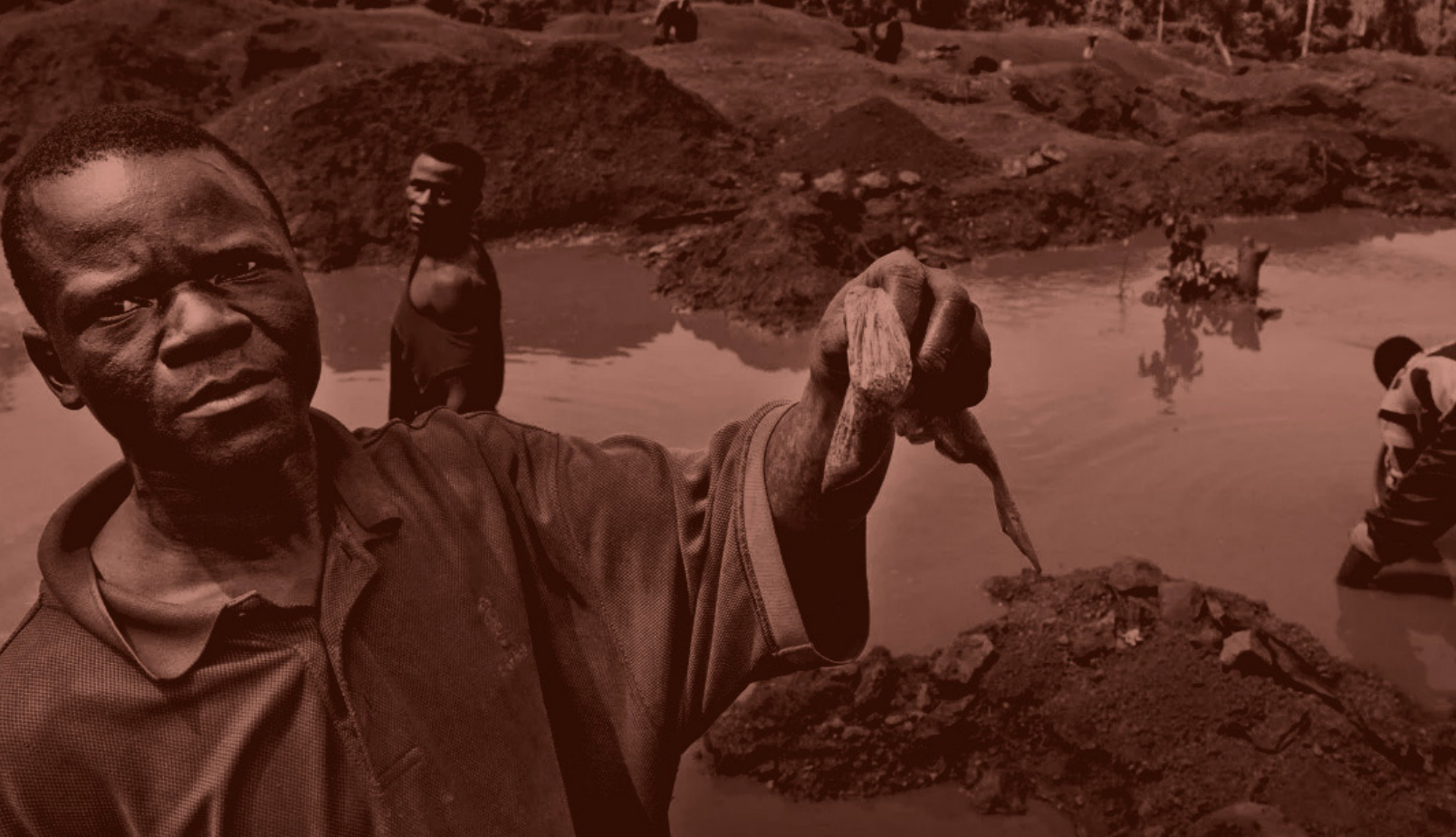
The RMI conformance is real. The minerals are real. Yet liability accumulates because the system in place to certify minerals required to recharge batteries and run AI data centers doesn’t bother to look upstream of a smelter that itself has noted dozens of problems with its own suppliers: particularly those based in the Eastern Congo where men, women and children right now pull rocks out of the earth often under the watchful eye of a young man carrying an automatic rifle.
The cooperative, the traders, and twenty years of documented network
M23 consolidated control of the Rubaya concession in North Kivu, one of the world’s richest coltan deposits, in April 2024. The Rwanda Defence Force, sanctioned by OFAC twelve months later, had provided troops, training, drones, and GPS jamming equipment in exchange for access to mineral-rich territory. By taxing mining operations at sites including Rubaya, M23 was generating an estimated USD 300,000 per month.
Getting that mineral to market required commercial infrastructure. A cooperative. A pair of Hong Kong trading companies. A certification scheme. And individuals who had spent decades building the relationships that made it all work.
Coopérative des Artisanaux Miniers du Congo (CDMC) was the largest operator on the Rubaya concession. Evidencity’s INI records its chairman as John Crawley, a UK-born mining executive and former president (2017-2019) of the Tantalum-Niobium International Study Centre (TIC), the industry body that sets global standards for responsible tantalum sourcing. Crawley simultaneously served as a director of East Rise Corporation, a Hong Kong-registered trading company incorporated in 2011 that received minerals from CDMC and sold them onward to international smelters. A second Hong Kong trader, Star Dragon Corporation, operated within the same network, linked to both Crawley and his long-standing associate, Swiss businessman Chris Huber.
OFAC sanctioned CDMC, East Rise, and Star Dragon in August 2025 for purchasing conflict minerals from militia-controlled territory and materially supporting an armed group. The designation confirmed what UN Group of Experts reports had documented for years. East Rise had purchased over 50 tonnes of coltan from its DRC sources in May and August 2024, after M23’s seizure of Rubaya, and sold those minerals onward. Crawley has denied any connection to illicit sourcing. As of this writing, he has not been sanctioned.
The Huber thread runs deeper and older. Evidencity’s INI identifies Chris Huber as a Swiss businessman under criminal investigation by Swiss prosecutors in Bern for war pillaging and business ties to Rwandan-backed militias during the Second Congo War (1998–2003) — a case that ended in acquittal on appeal in January 2026. Huber has consistently denied any involvement in illicit mineral trading. Through two Rwanda-based companies, Rudniki and Tawotin, Huber controlled approximately a quarter of Rwanda’s coltan export market at his peak. Together they functioned as the laundering mechanism: Congolese coltan smuggled across the border, reclassified as Rwandan origin, retagged through the ITSCI traceability scheme according to Global Witness, and re-exported as conflict-free. In 2020, Rwanda declared 3T mineral exports worth USD 800 million against an estimated domestic production of just USD 20–40 million. Yes, you read that correctly.
East Rise drew on both channels. According to INI data, the company received minerals from Rudniki, Tawotin, and Wolfram Mining and Processing, all Huber-linked Rwandan exporters, before routing them onward to Ulba.
The third figure in the network is less well known but no less significant. Simeon Briskin is a Russian entrepreneur described in Evidencity’s INI as “a notorious figure in the underworld of international mining.” He served as an adviser to former President Gorbachev, had established commercial links to Ulba Metallurgical Plant, and co-invested with Huber in Rudniki around 2006, approaching Czech geologist Jerry Fiala, Rudniki’s founder, and buying into the company on the condition that it sell exclusively to Niotan Inc., a US tantalum powder producer in which Huber held shares, and Crawley served as director. According to Fiala’s own testimony, Briskin told him the end goal was to sell Rudniki to Ulba for $2–3 million. Between 2007 and 2014, Huber and Briskin progressively diluted Fiala’s shareholding until he lost control entirely. Tax, banking, and production documents obtained by Fiala show that over $150 million in minerals moved through Rudniki in that period, volumes that far exceeded its actual production capacity.
This architecture predates the most recent sanctions by a generation. Evidencity’s INI flags Eagle Wings Resources International, a Rwanda-based coltan comptoir with documented ties to the Rwandan regime, as having exported conflict-linked coltan directly to Ulba as far back as 2002, per a UN report. The same smelter. A different network. Two decades earlier.
A Kazakh state asset with 117 “incidents”
Ulba Metallurgical Plant JSC was commissioned in 1949 in Ust-Kamenogorsk, in what was then Soviet Kazakhstan. It was built as a nuclear facility and processed uranium for the Soviet weapons programme. In November 1994, approximately 600 kilograms of weapons-grade uranium were removed from the plant to the United States under Project Sapphire, a classified operation to prevent the material falling into the wrong hands after the Soviet collapse.
Today, Ulba processes tantalum. It is a wholly owned subsidiary of NAC Kazatomprom JSC, the world’s largest uranium producer, majority-owned through Kazakhstan’s sovereign wealth fund Samruk-Kazyna, whose sole shareholder is the Government of Kazakhstan. At the top of the ownership chain sits President Kassym-Jomart Tokayev, who has spent his tenure constructing what Astana calls a “multi-vector” foreign policy: $17 billion in agreements signed with Washington in November 2025, a comprehensive strategic partnership declaration signed with Moscow the same month, and nuclear power plant contracts awarded simultaneously to Russia’s Rosatom and China’s CNNC, companies sanctioned by Ukraine and the U.S., respectively. Kazatomprom’s own governance history is not unblemished: its former president, Mukhtar Dzhakishev, was sentenced to 14 years in prison in 2010 for theft and corruption related to uranium contracts, including the sale of uranium assets to Rosatom. He served 11 years before parole.
Ulba accounts for approximately 12% of total global tantalum supply and holds RMI Smelter ID CID001969. It is the only tantalum processor in this former Soviet satellite state and appears in a large number of certified supply chains. Manufacturers sourcing tantalum through the former Soviet republics have little to no “conformant” alternative. Its RMI conformance is real. Its audit trail is documented. And its own Responsible Minerals Assurance Process (RMAP) audit reported 117 high-risk incidents in a single reporting period, all related to tantalum sourced from or transported through Conflict-Affected and High-Risk Areas. Ulba reported that it chose to continue trading with all relevant suppliers.
The connections to the network run long. Evidencity’s INI records that Eagle Wings Resources International, a Rwanda-based coltan comptoir with documented ties to the Rwandan regime and flagged for mineral laundering, exported conflict-linked coltan directly to Ulba as far back as 2002, per a UN report.
The most recent documented purchases are more direct. In May and August 2024, after M23 and the Rwanda Defence Force had consolidated control of the Rubaya mines, Ulba imported over 50 tonnes of coltan from East Rise Corporation. East Rise was designated by OFAC in August 2025. Ulba was not. Its RMI conformance was not reviewed. Its smelter ID remains active on the conformant list.
When a major S&P 500 electronics manufacturer filed its 2024 Conflict Minerals Report with the SEC on 29 May 2025, it listed Ulba Metallurgical Plant JSC as a confirmed tantalum smelter in its supply chain. The filing acknowledged an increased number of high-risk smelters compared to prior years, attributing this directly to government sanction-related activity. It acknowledged it could not determine the origin of all conflict minerals in its products with absolute assurance. Remediation, it said, would take time.
The filing is compliant. RMI conformance at the smelter level does not screen for what the smelter bought, from whom, and when. The minerals moved. The certification held. The filing is now public record, and so is the purchase trail that sits behind it.
Two tracks, no mechanism connecting them
On 2 March 2026, the same day OFAC designated the Rwanda Defence Force, Congo’s mines minister was finalising the approval paperwork for the sale of Chemaf SA, owner of two significant copper and cobalt operations in Haut-Katanga, to Virtus Minerals, a Delaware-registered firm led by veterans of American military and intelligence services. The approval was signed thirteen days later, under the banner of a December 2025 US-Congo strategic minerals partnership backed directly by the National Security Council (NSC) and the State Department.
Copper and cobalt are not 3TG minerals. Chemaf sits in a different supply chain, a different province, a different disclosure regime. The deal is not the story. The timing reveals the environment in which the tantalum sanctions landed: Washington simultaneously designating Rwanda’s military for sustaining conflict mineral networks in North Kivu and lobbying Kinshasa to approve a strategic asset acquisition in the same country, on the same timeline, without a visible mechanism connecting the two decisions. Treasury was acting on one track. State and the NSC were acting on another. While the tantalum track suffered from the illusion of compliance, the copper-cobalt track appears to proceed with a near total absence of accountability.
For corporate counsel and due diligence professionals, the architecture documented here raises a question that goes beyond any single filing or designation. Every entity in this chain held something clean on paper. CDMC operated under ITSCI certification. East Rise purchased from certified exporters. Ulba remains on the conformant list. The S&P 500 manufacturer’s conflict minerals report is publicly filed and formally compliant. From 2017 to 2019, John Crawley held the presidency of the Tantalum-Niobium International Study Centre (TIC), the industry body that sets responsible sourcing standards. James Kabarebe, the Rwandan defence minister sanctioned by the United States in February 2026 and alleged by Global Witness to have co-founded the ITSCI scheme alongside minerals trader David Bensusan, held a cabinet position and allegedly gained personally from smuggling conflict minerals while the mechanism he helped construct was certifying the minerals moving through it.
None of this is visible to entity-based screening. Screening checks names against lists. It does not map the relationships between a UK mining executive chairing a DRC cooperative while directing a Hong Kong trading company. It does not connect a Russian entrepreneur’s commercial links to a Kazakh state smelter to his co-investment in a Rwandan vehicle that laundered $150 million in Congolese minerals. It does not flag a certified smelter’s purchase of 50 tonnes of coltan from a trader operating out of mines under armed group control, because the purchase occurred before the designation, and the certification was never revisited after it.
The exposure accumulates at the downstream end. Manufacturers who source tantalum through Ulba are sourcing through a state asset embedded in a geopolitical balancing act, with a documented 20-year history of purchases from conflict-linked traders and 117 self-reported high-risk sourcing incidents in a single audit period. Their conflict minerals reports may be compliant. Their supply chains carry risk that compliance documents are structurally incapable of surfacing.
Evidencity’s INI mapped the full entity network, including Crawley, Huber, Briskin, CDMC, East Rise, Star Dragon, Rudniki, Tawotin, Eagle Wings, Ulba, and Kazatomprom, tracing their connections to downstream S&P 500 manufacturers, before a single OFAC designation landed. The INI does not wait for a sanctions list to identify a risk. It maps the network. The designation confirms what the network already showed.
The gap between what sanctions reached and what certification still covers is a structural feature of an outdated due diligence architecture that was built to disincentivize a look this far upstream.