Ghana recovered 39.4 tonnes of smuggled gold without tracing any of it to a mine
A Ghanaian government economic assessment credits the country's new gold board with pulling 39.4 tonnes of previously smuggled gold into formal export channels in 2025.
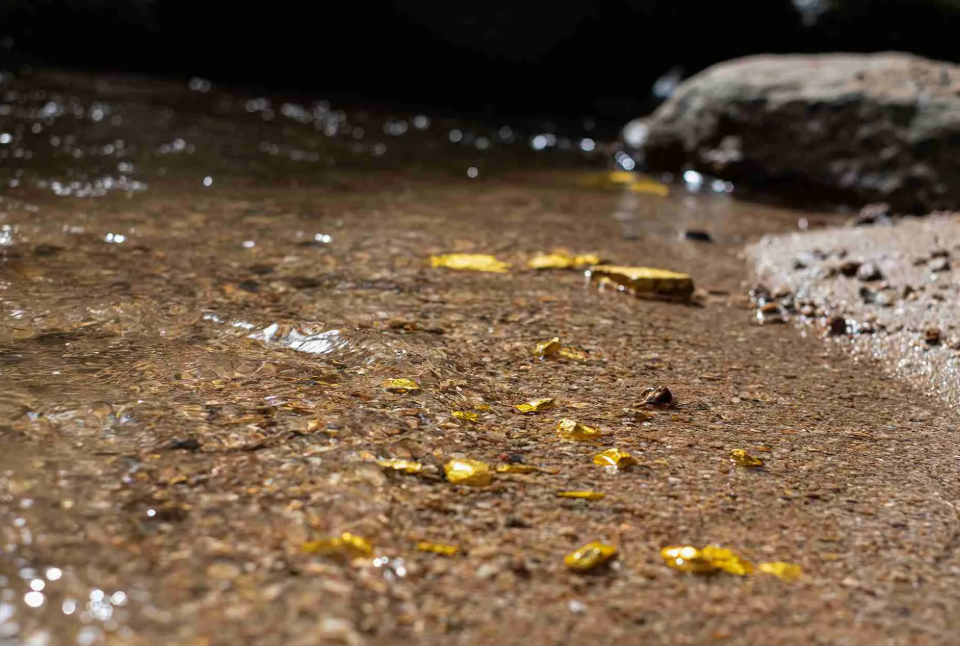
A Ghanaian government economic assessment credits the country's new gold board with pulling 39.4 tonnes of previously smuggled gold into formal export channels in 2025. That gold is worth an estimated USD3.8 billion in new foreign exchange. That figure captures the export leg of the trade only; the mining and first-purchase stages, where illegal and legal gold most often mix, sit outside it. Ghana's illegal mining sector is large enough that the two questions, where gold is exported from and where it is mined, rarely have the same answer.
GoldBod's numbers look like the smuggling problem is closing
On 11 June 2025, the Swiss NGO SWISSAID
documented a 229-tonne gap between Ghana's declared gold exports and the imports recorded by trading partners between 2019 and 2023. The same report estimated that gold smuggling cost Ghana USD11.4 billion in lost revenue over that period. Smugglers reportedly routed most of the missing gold to Dubai through Togo or across the Burkina Faso and Mali borders.
Ghana's response was the Ghana Gold Board (GoldBod), a state body created to centralize the purchasing, assaying, and export licensing of artisanal gold. It also restricts foreign participation in the domestic trade and backs the new system with a security enforcement task force. A technical report dated 4 January 2026
credits GoldBod with formalizing 39.4 tonnes of gold in 2025. Economists from the University of Ghana and the University of Ghana Business School prepared the report. The authors describe that gold as plausibly having been smuggled out of the country in the past but now captured through GoldBod's formal purchasing and export framework. They attribute the shift to the board's competitive pricing. The report puts the benefit-cost ratio of formalization at roughly 18 to 1.
Unlicensed gold blends with legal supply before GoldBod ever sees it
The formalization figure reflects a shift in where gold is exported from, distinct from where it is extracted. The Africa Center for Strategic Studies
reported on 21 July 2026 that illegal artisanal mining, known locally as galamsey, now generates roughly USD11 billion in foreign exchange. Ghana's licensed large-scale mining sector generates roughly USD9 billion by comparison. An estimated 700,000 to 800,000 miners work without a license across 120 of Ghana's 261 administrative districts. The laundering point sits well upstream of any export license. Local “bush buyers” purchase gold directly from unlicensed miners in cash, often with no documentation, before selling it on to intermediaries at regional trading hubs such as Kumasi. At that stage, intermediaries routinely blend illegally mined gold with legally sourced production, and the blend is what eventually reaches a licensed buyer, an assayer, or GoldBod itself.
A parcel that clears GoldBod's centralized purchasing system now carries a cleaner export paper trail than it did before 2025, but no verified record of the mine it came from. GoldBod formalizes the export leg of the chain; the mixing happens at a stage its statistics do not reach.
A parallel gap moves gold north into Burkina Faso
A parallel version of the same opacity operates in Ghana's north, and it points toward a different kind of exposure. The Global Initiative Against Transnational Organized Crime (GI-TOC)
found that 60% to 70% of gold mined in northern Ghana is sold to Burkinabe traders and smuggled into Burkina Faso. Those flows run on prefinancing arrangements that secure the gold before it is even extracted, concentrating financial control outside Ghana.
GI-TOC found no evidence that Jama'at Nasr al-Islam wal Muslimin (JNIM) currently taxes or finances mining operations in northern Ghana. The conditions GI-TOC documented there, informality, porous borders, opaque prefinancing, and marginalized Fulani communities, mirror what JNIM has exploited in Mali, Burkina Faso, and Côte d'Ivoire. The group already draws on Ghana's Upper West region for fuel, motorbikes, and explosives. Since 2024, JNIM has expanded southward.
GoldBod's statistics stop before the mine
For a compliance team, Ghana's national gold export data, and GoldBod's own formalization numbers, describe the state of one node in the chain: the export license. They do not describe whether intermediaries blended the underlying parcel with unlicensed ore before it reached that node. Nor do they capture the cross-border financing arrangements that route a share of northern Ghana's output into Burkina Faso. Gold mining already helps finance JNIM's insurgency elsewhere in that country, though GI-TOC found no direct evidence tying this specific flow to the group. A sourcing program built on national export statistics only audits the reformed layer of the chain. Extraction and first purchase, the layer with no statistics at all, is where the real exposure sits.